Why Most Renewable Energy Land Deals Fail After the LOI Stage
Verified Acres Team
Verified Acres Team
In this blog, you will get to know:
● Why most renewable energy projects fail due to unstructured land acquisition
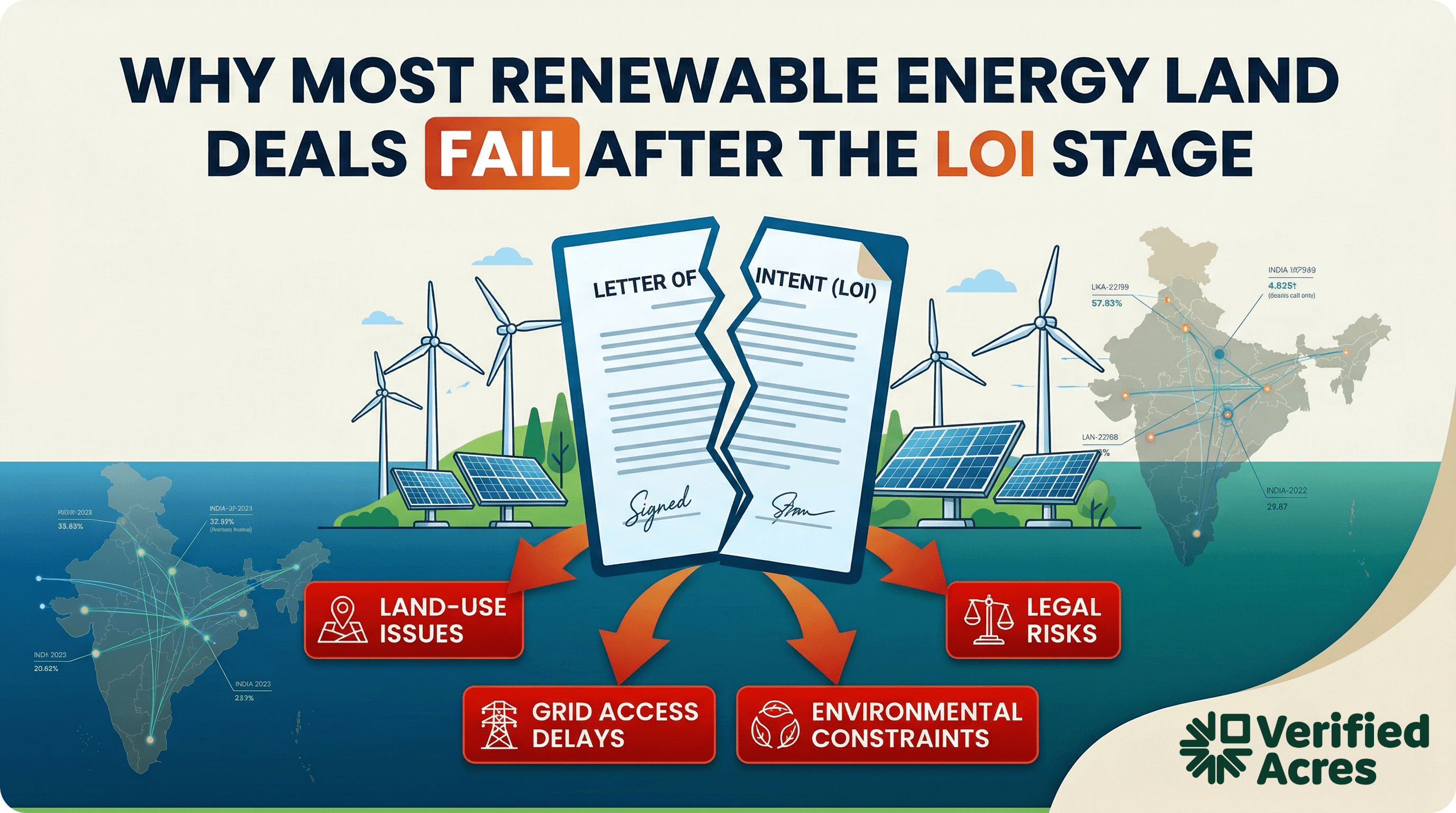
● Why renewable projects fail just after the LOI stage
● Best tools and platforms for land acquisition, especially for a renewable energy project?
The Indian government is investing heavily in 2026 to achieve the renewable energy development goals set by the country. But the biggest challenge for renewable energy developers remains the same, i.e., signing a Letter of Intent (LOI) for better land acquisition. After months of scouting for renewable energy land in India, negotiating with landowners, and reviewing potential sites for a solar project or wind installation, it does not sound safe and also invites numerous doubts.
The thing that remains true in this industry is that many deals are signed with a lot of unwanted circumstances and land restrictions after the LOI phase. This is particularly true with solar farming projects in India, as optimism is one thing, but reality is another. By the time a solar farm fails, much money has already been spent on surveys, consultants, travel, etc.
It is very important to understand this uncertainty while choosing land for renewal development, as it will not only save a huge amount of money, but also create a better list of solid projects for the future.
The LOI Illusion: Commitment Without Full Visibility
Usually, an LOI indicates intention rather than detecting the feasibility of the land. It may be executed before the completion of a feasibility study for a renewable energy project.
That's why most failures occur when key risks become apparent during the process of due diligence.
Land Requirements Are Often Misunderstood
One of the first surprises developers encounter is that the actual land required for solar power plant development may differ from initial estimates. For example, the commonly cited 1 MW solar power plant land requirement of 4–5 acres can vary significantly depending on terrain, technology, and spacing needs.
Generally, issues include:
● Irregular parcel shapes reduce the usable area
● Sloped terrain increases civil work costs
● Access road limitations
● Flood risk zones
● Fragmented ownership across contiguous plots
Even when sufficient acreage exists on paper, the effectiveness of land availability for a solar farming project may be far lower than it appears on paper.
This mismatch can ruin project economics, especially when lease costs are high.
Lease Economics Shift After Due Diligence
Although reality is more erratic, land negotiations often assume stable lease pricing. When investigating solar farm lease rates per acre in India, especially in Maharashtra or Gujarat, developers frequently find hidden factors like:
● Escalation clauses
● Local market speculation
● Competing developers are driving prices upward
● Restrictions on long-term leasing of agricultural land
According to an Indian Express report, non-strategic land acquisition projects and RoW issues led to 25 renewal project delays, including Gujarat, Rajasthan, and other states.
Land Use Rules and Conversion Delays
A major barrier to solar farming in India is land classification. Most of the available land is agricultural, requiring formal conversion for industrial use.
Challenges in land conversion for solar projects in India include:
● Lengthy approval timelines
● State-specific regulations
● Restrictions on fertile farmland
● Government or forest land overlaps
● Policy changes mid-process
Understanding land use rules for solar power plants is critical, yet these rules are often interpreted differently at district levels.
For developers, delays in conversion can hinder tender deadlines or power purchase agreements, forcing them to abandon sites.
Environmental and Forest Restrictions
Environmental compliance is another late-stage deal killer. Parcels may fall within or near protected areas, triggering requirements for environmental clearance for solar land development.
Common obstacles include:
● Forest land rules for solar projects
● Wildlife corridors
● Wetlands and water bodies
● Coastal or ecologically sensitive areas
● Flood zones
These factors make it difficult for land due diligence for renewable projects in India, forcing project managers to extend timelines beyond acceptable limits.
Grid Availability: The Biggest Hidden Risk
Perfect land is not enough; the developer also needs access to the grid in order to produce power.
Some of the key issues identified by detailed analysis are:
● Substations operating at capacity
● High cost of building new transmission lines
● Regulatory approvals for connectivity
● Land acquisition for transmission corridors
● Technical constraints in the network
The substation distance solar project factor alone can determine whether a site is viable or not. Long distances increase losses, capital costs, and approval complexity.
Critical considerations include:
● Transmission proximity for solar projects
● Grid evacuation feasibility solar
● Grid constraints on renewable projects
● Solar grid connectivity analysis
A site that seemed feasible during early mapping, but may fail when engineers conduct a detailed study.
Geospatial Reality vs Ground Reality
Modern developers rely heavily on digital tools for gis based renewable site analysis and geospatial analysis for solar projects. These tools are valuable for early filtering, but fail to capture every on-ground activity.
Hidden issues discovered during surveys may include:
● Encroachments
● Unrecorded settlements
● Seasonal waterlogging
● Access disputes
● Soil instability
Therefore, effective solar site suitability analysis requires a perfect combination of satellite data with local intelligence. And that can only be possible through platforms like Verified Acres.
Ownership Complexity and Legal Risks
Land ownership issues remain one of the biggest challenges in renewable land acquisition. Even when documents appear clean, a deeper investigation may reveal disputes or unclear titles.
Typical risks include:
● Multiple heirs with consent requirements
● Pending litigation
● Informal tenancy claims
● Boundary conflicts
● Outdated records
These legal uncertainties represent major legal risks in renewable land acquisition, often forcing developers to abandon projects to avoid future disputes.
Community and Social Factors
Land is indeed a valuable asset and a reliable source of income. But concerns about displacement and the loss of grazing land or other environmental impacts can interrupt the flow of the renewable project within the community.
This is so true for regions targeted for large-scale solar farming project development, where thousands of acres are involved.
Concerns commonly include:
● Employment expectations
● Compensation fairness
● Water usage fears
● Cultural or religious site impacts
These issues are hard to predict during early negotiations, but can ruin projects completely while closing the deal.
Renewable Site Selection Is Increasingly Data-Driven For Best Results
To counter these arising problems, successful developers now treat renewable energy site selection as a structured, data-intensive process rather than a broker-led search.
Modern evaluation incorporates:
● Solar site evaluation factors
● Transmission proximity
● Environmental sensitivity
● Land conversion feasibility
● Ownership clarity
● Economic modelling
Advanced tools enable solar project site ranking and allow teams to compare solar project sites objectively before committing resources.
Why Early Screening Matters The Most
The recurring theme across failed deals is late discovery of risk. By the time problems surface, teams are already committed.
This is why early-stage site screening of renewable projects has become a best practice. Identifying weak sites before signing an LOI saves months of effort and protects capital.
Effective screening focuses on:
● Land shortlisting for renewable projects
● Renewable land due diligence
● Solar land availability in India
● Renewable project development tools
● Site intelligence for renewable projects
Developers increasingly rely on specialised platforms that integrate these insights into a single decision framework.
How Verified Acres Helps Reduce Post-LOI Failures
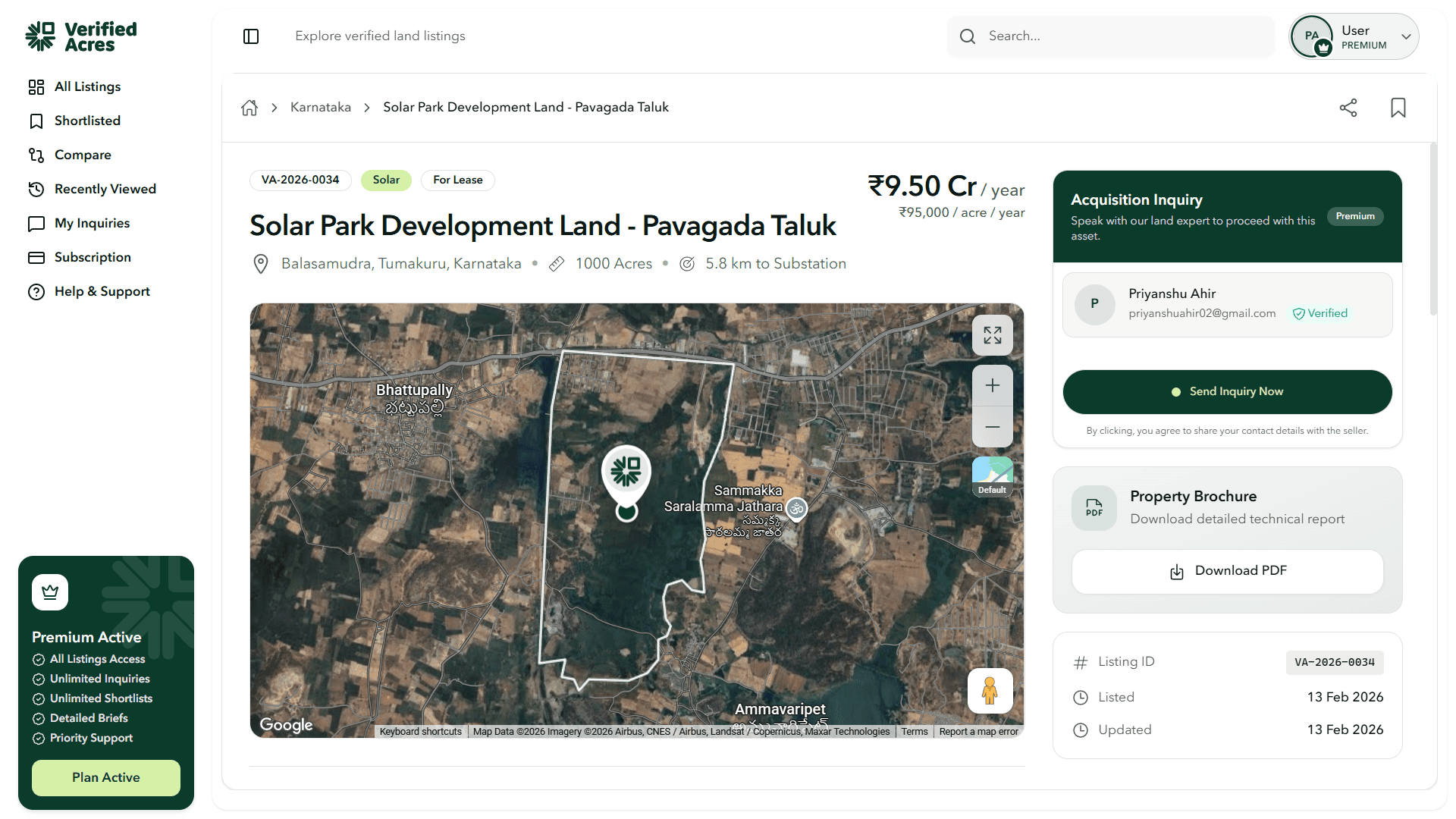
Verified Acres is India's #1 Land Acquisition Platform for Renewable Energy Developers, IPPs & EPCs. It enables an end-to-end value chain from Land identification to land registration. Verified Acres was built specifically to address the uncertainty surrounding renewable energy land in India. Rather than acting as a listing portal, it functions as a renewable land intelligence platform designed for developers to ensure the safety parameters of land selection for renewal projects.
Its approach emphasises decision support before commitment, the stage where most costly mistakes occur.
Key advantages include:
Integrated Site Intelligence
The platform aggregates multiple datasets to support solar site suitability analysis and wind evaluations, including terrain, resource potential, and environmental sensitivity.
Grid and Infrastructure Insights
Understanding transmission proximity for solar projects and grid evacuation feasibility early helps eliminate sites that cannot realistically deliver power.
Risk Signalling for Land and Legal Issues
Early indicators highlight potential challenges related to ownership, classification, and conversion — core elements of renewable project land due diligence in India.
Comparison and Shortlisting Tools
With tools and platforms like Verified Acres, developers can efficiently compare solar project sites, rank options, and focus on parcels with the highest probability of success.
India-Specific Context
Because policies, land records, and grid infrastructure vary by state, India-focused intelligence is essential for accurate renewable energy site selection.
Choosing the Right Land Is the Real Competitive Advantage
As competition intensifies and prime locations become scarce, the ability to identify the best locations for solar power plants quickly and confidently will define successful developers.
This applies not only to solar but also to wind, where wind farm site selection criteria and wind energy land requirements in India introduce additional layers of complexity.
The future of renewable development will be shaped not by who signs the most LOIs, but by who selects the right sites earliest.
Conclusion
Renewable land deals rarely fail because developers lack ambition or expertise. They fail because crucial information is identified too late in the process.
In a sector driven by tight timelines and capital efficiency, late surprises are costly. Whether it involves grid constraints, land conversion hurdles, environmental restrictions, or ownership disputes, the common thread is insufficient early visibility.
For organisations pursuing solar farming in India or large-scale wind projects, investing in rigorous pre-LOI screening is no longer optional; it is a part of the strategy.
The successful renewable projects are not those that move fastest after signing an LOI, but those that were chosen carefully long before it.
Verified Acres Team
Verified Acres Team
A dedicated team of renewable energy and land intelligence experts committed to simplifying land acquisition for developers across India.
Share this post: