Renewable Energy Site Selection: Why Land Suitability Is the Foundation of Every Successful Project
Verified Acres Team
Verified Acres Team
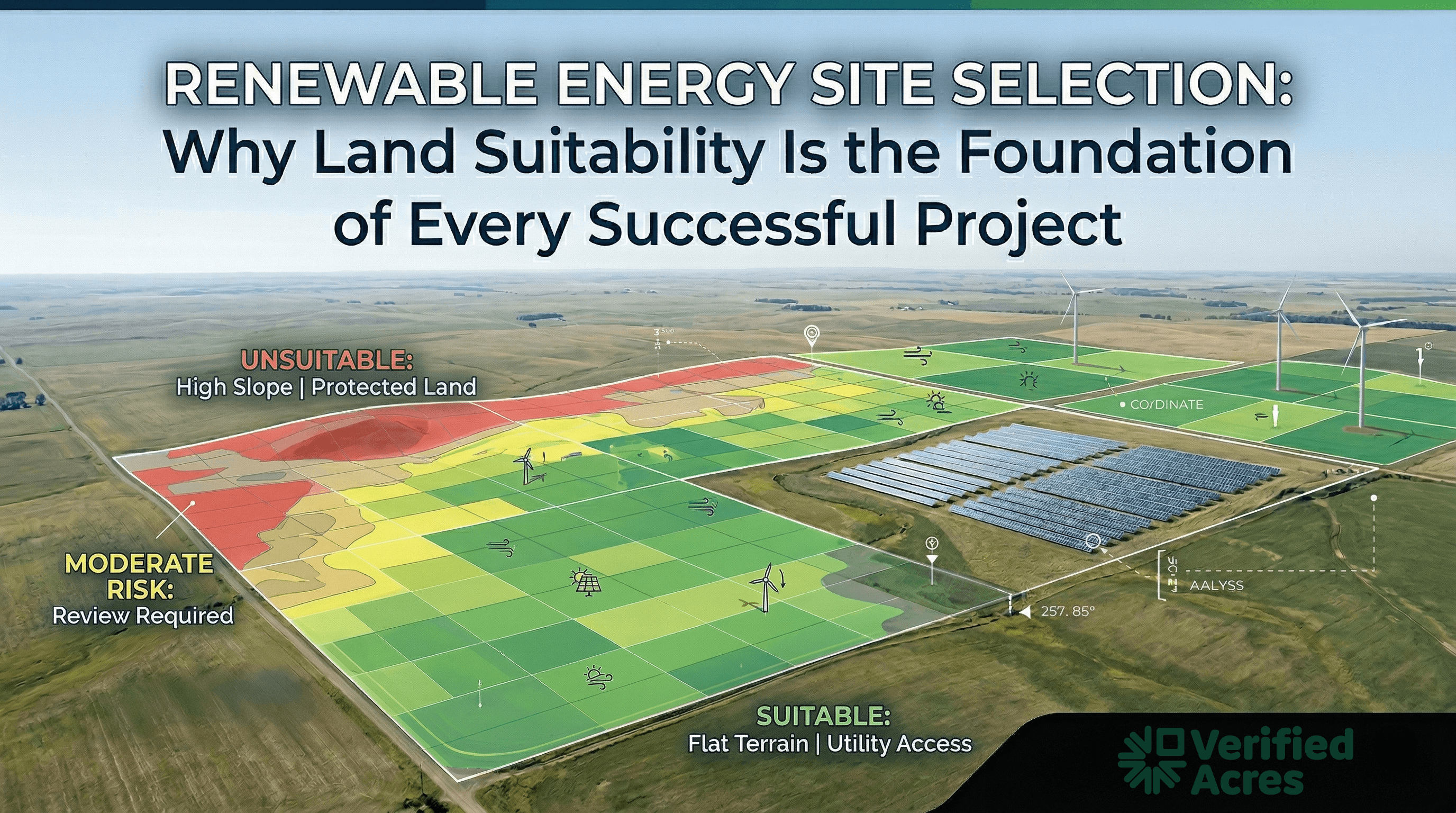
India’s renewable energy projects are moving at a very high speed for meeting 2026 targets. With strong policy back-ups, developers are actively acquiring land for new solar and wind installations. However, on the surface, it appears as a growth story without limits. But, it’s a fact that a large number of renewable energy projects collapse quietly after the Letter of Intent (LOI) stage.
In this blog, you will get to know:
Why most renewable energy projects fail due to unstructured land acquisition
Why renewable projects fail just after the LOI stage
Best tools and platforms for land acquisition, especially for a renewable energy project
The reality is not about lack of opportunity, but about how land is selected. Renewable energy site selection is not just an early step — it is the foundation that determines whether a project will survive or fail.
The Real Problem During Site Selection for Renewal Energy Projects: Unstructured Land Acquisition
A typical renewable deal begins with optimism. Teams spend months exploring renewable energy land in India, identifying parcels, negotiating with landowners, and shortlisting sites that appear promising for a solar farming project. Once the numbers seem to align, an LOI is signed.
However, in many cases, this process is not organized. Decisions are often affected by local inputs, incomplete data, or urgent land security from competitors. A detailed renewable project feasibility study is either rushed or only partially completed.
This creates a fragile starting point. The land may appear viable initially, but underlying risks remain hidden. By the time developers begin deeper analysis, the reality starts to unfold, and that is where most projects begin to struggle.
The LOI Illusion: Commitment Without Full Visibility
An LOI creates a sense of progress. It signals that both parties are aligned and ready to move forward. But in reality, it does not confirm feasibility.
Many developers enter this stage without fully validating key parameters such as solar grid connectivity analysis, land classification, or environmental conditions. What follows is a phase of detailed due diligence where unexpected issues start appearing.
Factors including grid constraints, unclear ownership records, or delayed approvals can quickly shift the momentum of the project. These challenges look minor; but they directly affect timelines, cost structures, and execution feasibility.
This is why the stage after signing an LOI often becomes the most uncertain phase in a renewable project lifecycle.
Land Requirements Are Often Misunderstood
One of the earliest miscalculations in a solar farming project is the estimation of land. On paper, developers often assume a standard 1 MW solar power plant land requirement of around 4–5 acres. In practice, the land required for solar power plant development varies significantly.
Undoubtedly, terrain plays a major role. A flat, well-shaped parcel is far more efficient than land that is uneven or fragmented. Even if the total acreage is sufficient, irregular boundaries can reduce usable space. Road access, spacing between panels, and infrastructure requirements also influence actual land utilisation.
This gap between assumed and real capacity becomes especially noticeable in regions known for solar farming in Gujarat or Maharashtra, where competition for suitable land is already high. What appears sufficient at the negotiation stage may turn out to be inadequate during execution.
According to the Construction World.in report, “States including Andhra Pradesh, Gujarat, Maharashtra and Himachal Pradesh are facing heavy delays due to land acquisition issues, legal cases, and environmental clearances.
Lease Economics Shift After Due Diligence
At the early stage, financial projections are often built around estimated solar farm lease rates per acre in India. These assumptions help developers evaluate project viability and proceed with negotiations.
However, once due diligence begins, the financial picture tends to change. Lease contracts may also have escalation clauses, local demand may drive up costs, and policy constraints on agricultural land for solar power plants may also come into the equation.
For some markets, land leasing rates for solar farms in Maharashtra may differ based on the location’s proximity to infrastructure. However, these differences may seem small, but they may add up and affect the project’s viability.
Later, developers notice that what started as a financially viable project may no longer meet expected returns.
Land Use Rules and Conversion Delays
Land classification remains one of the most complex aspects of solar farming in India. A large portion of available land falls under agricultural use, which requires formal conversion before it can be used for industrial purposes.
The process of transforming land for solar projects in India is often a big challenge. Approval timelines by courts can extend unpredictably, and regulations can differ from state to state. Certain policies can massively affect the project process and can create more uncertainty.
Understanding land use rules for solar power plants is important, but these rules are not always applied consistently at the local level. Even a minor delay in approvals can derail project timelines and highly impact agreements related to power supply commitments.
According to a report of projects today, “Tamil Nadu and Karnataka are also facing the same land acquisition problems for their renewable energy projects which can also increase the decided budget.”
Environmental and Regulatory Barriers
Environmental considerations often come up late in the process. A site that seems perfect during the initial evaluation may actually be in a restricted or sensitive area.
Environmental clearance for solar land requirements can lead to major delays. Restrictions tied to forests, wetlands, or wildlife corridors can negatively affect the project's progress.
These problems cannot be solved shortly. They need regulatory approvals, thorough assessments, and sometimes a full redesign of the project. For renewable energy developers, this often results in huge time and money wastage.
Grid Availability: The Most Underrated Constraint
Land alone does not make a renewable project successful. Without reliable grid access, even the best site cannot generate value.
People often underestimate the importance of renewable energy grid availability during early discussions. Developers may think that nearby substations can handle extra capacity, but thorough analysis often shows a different story.
Distance from the grid plays a critical role. The substation distance solar project factor directly impacts transmission costs, efficiency, and approval complexity. Greater distances mean higher investment and longer timelines.
In many cases, grid evacuation feasibility becomes the deciding factor. A site that seemed perfect in every other aspect may fail simply because it cannot deliver power efficiently.
The Gap Between Digital Analysis and Ground Reality
Technology has transformed how developers approach site selection. Tools based on gis based renewable site analysis and geospatial analysis for solar projects allow teams to evaluate large areas quickly. However, digital insights have limitations. They cannot fully capture on-ground realities.
During physical inspections, developers often encounter unexpected challenges such as informal settlements, access disputes, or seasonal waterlogging. These issues are rarely visible through satellite data alone.
This is why solar site suitability analysis must go beyond mapping. It requires a combination of digital intelligence and local validation to ensure accuracy.
Ownership Complexity and Legal Risks
In India, land ownership is hidden and complicated. Even when the documentation process seems clear, a deeper investigation can easily reveal multiple stakeholders or unresolved disputes over the same site.
These risks are very dangerous for the renewable project land due diligence in India. Issues such as outdated records, unclear boundaries, or informal claims can delay or even shut down the entire project.
A report of Business Standard shows that “Legal uncertainty is one of the most important reasons for developers to step back after signing an LOI for land acquisition for renewable energy development in India. The cost of resolving these disputes is often higher than the value of continuing the project.
Social and Community Dynamics of Land in India
Renewable projects, especially large solar farms, are often connected to local memories. In India, land is more than just an asset. For countless Indians, it provides a livelihood and is usually associated with cultural identity.
There are many problems associated with compensation, jobs, and the surroundings that can determine how Indian communities react to a renewable project site. These issues are not seen early, but they can become very hazardous later. A little lack of alignment with local stakeholders can slow down the complete progress of the project. In many cases, it lead to complete project abandonment.
Renewable Site Selection Is Becoming Data-Driven
Now, developers are quickly shifting towards AI insights and data-driven processes for land acquisition for renewable projects. They are integrating multiple factors into a single evaluation framework. This includes resource availability, grid connectivity, land classification, environmental sensitivity, and financial viability.
Advanced renewable energy mapping tools and software for renewable site selection allow teams to perform solar project site ranking and objectively compare different locations.
This shift is not just about efficiency; it is about reducing uncertainty before making commitments.
Why Early Screening Matters the Most
Renewable energy developers in India get to know the exact risk before it's too late, which is a common challenge in most of the renewable energy failed projects. By the time the risks are being identified and recognized, a lot of time and resources have already been invested and wasted in the projects.
Therefore, site screening for renewable energy has become the need of the hour. This helps in avoiding losses and making sure that only potential renewable sites are being taken up.
The process of site screening in renewable energy is critical and clearly demands a clear understanding of the availability of land for solar energy in India.
Best Platform for Renewable Land Acquisition
One of the toughest challenges in land acquisition is the unavailability of reliable AI tools and platforms. A unified AI-powered system for land acquisition can be the key game-changer
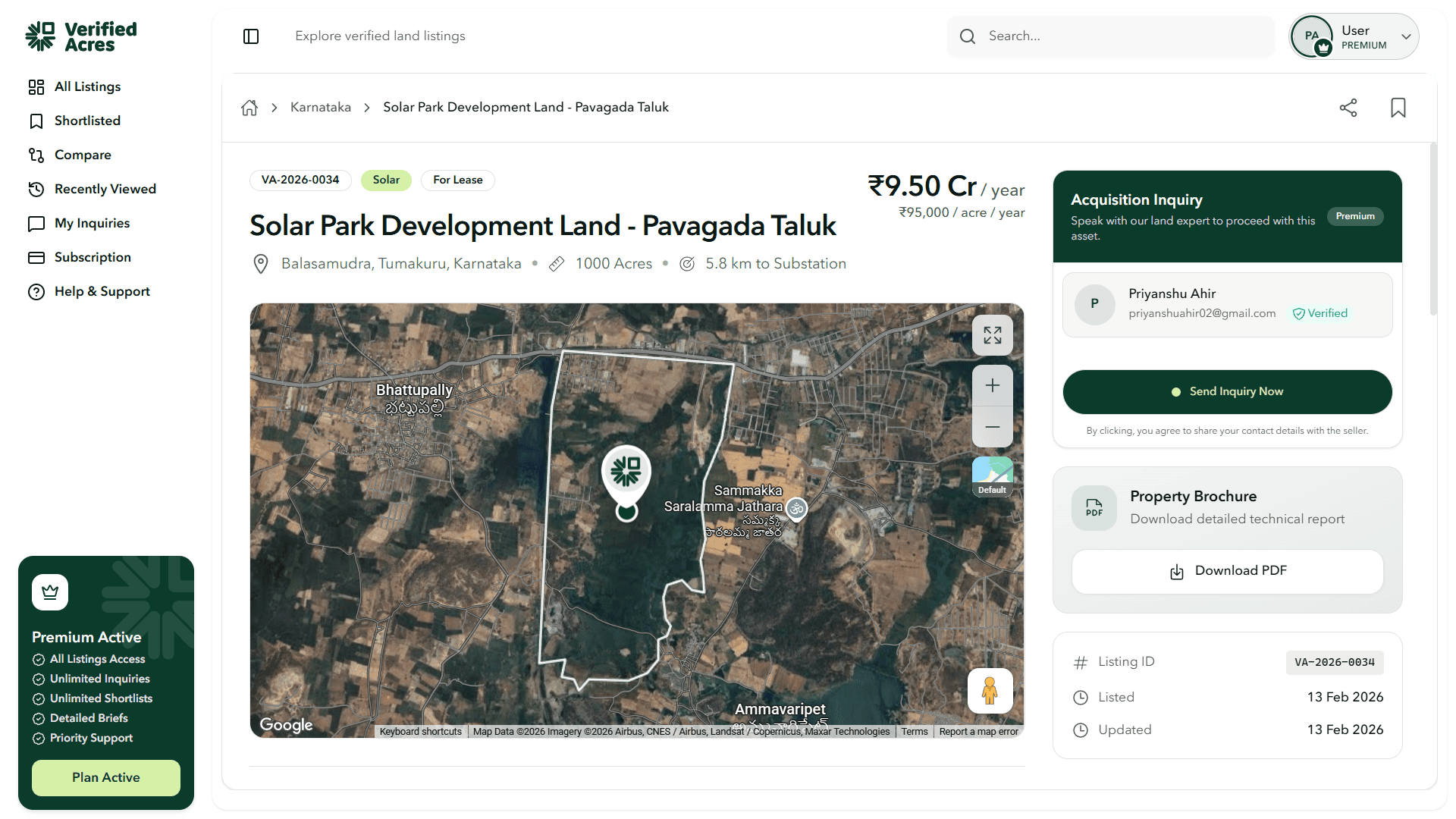
This is where platforms like Verified Acres are making a huge difference. It is India's Number 1 Land Acquisition Platform for Renewable Energy Developers, IPPs & EPCs. It enables an end-to-end value chain from Land identification to land registration. Here, developers can compare and analyse different land maps, land options, suitability, and other factors that determine land acquisition.
Instead of functioning as a basic listing portal, Verified Acres operates as a specialised renewable land intelligence platform built for developers. It supports the entire journey from land identification to evaluation and shortlisting.
The key point that makes this process valuable is the focus on the decision-making process prior to any commitment. This helps renewable energy developers to tackle the common mistakes that cause renewable site failures after the Letter of Intent through well-conducted surveys and key comparisons in crucial factors like grid connectivity, land classification, environmental sensitivity, and ownership risks. Developers and engineers should precisely identify these problems and eliminate high-risk land sites for a successful renewable project.
Choosing the Right Land Is the Real Competitive Advantage
As the renewable sector becomes more competitive, the ability to identify the right land quickly is turning into a defining advantage.
This applies equally to solar and wind projects. While solar projects depend heavily on land characteristics and grid access, wind projects introduce additional considerations such as wind farm site selection criteria and wind energy land requirements in India.
In both cases, success relies on clarity in the early stages. Developers who invest in structured site selection are in a stronger position to deliver the project well and prevent costly delays.
Conclusion
In short, Renewable energy projects don’t stall due to a lack of intention or investment. They stall due to a lack of critical information in the early stage of the judgment, like grid constraints, land conversion issues, environmental issues, and issues of ownership.
The selection of the renewable project site is not just a business decision; it's an important strategic long-term investment. Site selection for renewable energy projects must be a professional and organized process with real smart tools like Verified Acres. Solar farming developers or wind installation engineers in India must shift their approach from traditional land selection to smart land selection with AI for desired results.
Verified Acres Team
Verified Acres Team
A dedicated team of renewable energy and land intelligence experts committed to simplifying land acquisition for developers across India.
Share this post: