Beyond Solar GHI: What Else Matters in Land Evaluation for Utility-Scale Projects

Someone
Clean Tech Innovators
Quick Summary
Global Horizontal Irradiance (GHI) is a key metric in solar project planning—but relying on it alone can lead to incomplete or risky land decisions.
Utility-scale solar development requires a multi-dimensional evaluation that includes terrain, grid access, regulations, and long-term operational feasibility.
A well-evaluated site doesn’t just maximize energy output—it minimizes risk, cost overruns, and delays across the project lifecycle.
Beyond Solar GHI: What Really Matters in Land Evaluation?
When developers assess land for solar projects, GHI often becomes the headline metric. While it indicates solar potential, it does not capture the full picture. Land that looks perfect on paper can fail in execution due to overlooked constraints like poor connectivity, regulatory hurdles, or unsuitable terrain.
To build scalable and profitable solar projects, a deeper, more holistic evaluation is essential.
1. Topography and Terrain Complexity
Flat land is ideal, but slight slopes can improve drainage and panel efficiency. However:
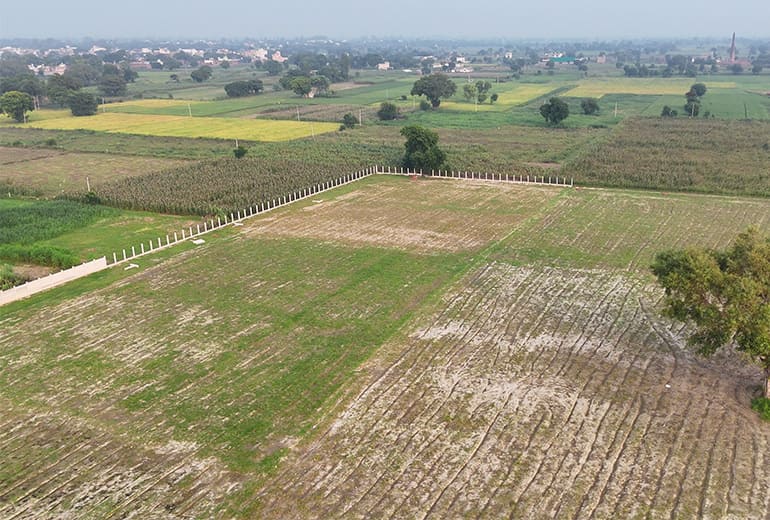
Steep slopes increase installation costs
Uneven terrain requires grading
Poor drainage can affect long-term stability
Understanding terrain early helps optimize layout and reduce civil engineering costs.
2. Soil and Geotechnical Conditions
Soil directly impacts foundation design and structural reliability.
Rocky land may require drilling
Loose soil may need reinforcement
High water tables complicate installation
Ignoring soil conditions can lead to major cost escalations during construction.
3. Grid Connectivity and Infrastructure
Even high-GHI land becomes useless without proper grid access.
Distance to substations impacts cost
Transmission capacity affects scalability
Grid congestion can limit output
In many cases, connectivity determines project viability more than irradiance.
4. Land Use, Zoning, and Compliance
Regulatory issues are one of the most common project blockers.
Agricultural land restrictions
Environmental clearances
Local zoning laws
Protected or disputed land
Early legal due diligence prevents delays and unexpected shutdowns.
5. Accessibility and Logistics
A project is only as efficient as its accessibility.
Road connectivity for heavy equipment
Distance from supply hubs
Seasonal accessibility challenges
Logistics directly influence both construction timelines and operational costs.
6. Water Availability
Water is essential for panel cleaning and construction.
Limited access can:
Increase operational expenses
Reduce plant efficiency due to dust accumulation
This factor becomes critical in arid regions.
7. Environmental and Social Factors
Ignoring environmental and community aspects can derail projects.
Impact on ecosystems and wildlife
Local community acceptance
Risk of land disputes
Sustainable projects must balance development with responsibility.
8. Climate and Weather Variability
Beyond average sunlight, consistency matters.
Dust levels (soiling losses)
Seasonal cloud patterns
Extreme weather risks
These directly impact energy yield and maintenance planning.
9. Shadow and Obstruction Analysis
Even minor shading can reduce efficiency across large installations.
Nearby trees or structures
Terrain elevation differences
Accurate shadow analysis ensures optimal panel placement.
10. Land Cost vs Lifecycle Value
Low-cost land can be misleading.
High development costs
Infrastructure investments
Operational inefficiencies
The focus should always be on long-term ROI, not just acquisition price.
“In solar development, the best land is not the one with the highest GHI—but the one with the fewest hidden risks.”
The Importance of Holistic Site Evaluation
Successful solar projects are built on balanced decision-making. Developers who evaluate land across technical, environmental, and economic dimensions are better positioned to avoid delays and maximize returns.
A strong evaluation framework reduces uncertainty and creates a clear path from planning to execution.
Turning Complexity into Opportunity
While land evaluation may seem complex, it also creates opportunities for smarter decision-making. Developers who go beyond surface-level metrics like GHI gain a competitive advantage—identifying sites that are not only viable but also scalable and cost-efficient over time.
Someone
Clean Tech Innovators
Someone focuses on building intelligent, data-driven solutions for renewable energy and real estate sectors. By simplifying complex processes like land evaluation, the team helps developers make faster, smarter, and more reliable decisions for large-scale infrastructure projects.
FAQs
Share this post: